Is your lab-grown diamond green? What the carbon numbers say

Director, Colour Gemstones, eValuer FZCO
Walk into a lab-grown jewellery boutique in London, New York or Dubai and you will probably be told that a lab-grown diamond is the responsible choice. Nothing is dug out of the ground, so the planet is spared. Some brands go further and sell lab-grown as part of the answer to climate change.
I have spent 35 years in the diamond trade, at De Beers, BHP Billiton and Grib. Over those years, up to 2023, I got to know most of the major manufacturers in Surat personally, and many of them now grow and cut lab-grown diamonds as well. I have no quarrel with lab-grown diamonds. They are similar to but not exactly the same as natural diamonds (if they were then we wouldn’t have machines that can detect them), and the best Indian growers produce beautiful stones. My quarrel is with environmental claims that nobody checks. So I checked them.
Mined against grown.
The most widely quoted figure for mined diamonds comes from a study by Trucost, part of S&P Global, commissioned by the Diamond Producers Association (now The Diamond Collective) and published in 2019. Using 2016 data, it found that the major miners emitted 160 kg of CO2 equivalent for every polished carat they produced.
For lab-grown, the most credible figure I have found comes from Pandora, which stopped using mined diamonds in 2021 and now publishes the carbon footprint of every lab-grown stone it sells. A one carat Pandora stone carries 12.58 kg of CO2e, calculated by external life-cycle specialists and verified by EY. That is about 92% below the Trucost figure for mined stones.
That number rests on one condition. Pandora says all of its lab-grown diamonds are grown with 100% renewable electricity. When its study modelled the same stones on local grid electricity, the footprint rose to roughly 180 kg per carat, a little above the miners.
Other estimates are higher still. Only Natural Diamonds, the consumer campaign of the Natural Diamond Council (now The Diamond Collective), puts lab-grown diamonds produced in India at 612 kg per carat and those from China at 523 kg. The council has an obvious interest and has not published its method, so I treat those figures as an upper estimate.
[Author's update : In 2021 the US National Advertising Division found the Trucost comparison between mined and lab-grown emissions unreliable, and the Natural Diamond Council (now The Diamond Collective) agreed to stop using it. The 160 kg figure should be read with that in mind. The comparison between grid-powered and renewable-powered lab-grown diamonds, from Pandora's verified study, is unaffected.]
The grid.
A lab-grown diamond is an electricity product. A CVD reactor runs for weeks to grow a single batch, and almost all of the stone's carbon comes from the power station at the other end of the cable. The same stone can carry 13 kg of carbon or 180 kg, depending only on where the electricity came from.
That makes India's power supply the most important number in this debate. According to Edahn Golan, India became the largest producer of gem-quality lab-grown diamonds by volume in 2025, growing about 8% more carats than China, and it polishes virtually all of the world's lab-grown output. According to Ember, fossil fuels generated 73% of India's electricity in 2025, most of it from coal.
Indian growers are already changing this. Greenlab Diamonds in Surat runs on its own solar and wind plants in Bharuch district. JK Star Group says its AVP Star facility in Surat, with 500 CVD reactors, runs entirely on solar power from the group's plant in Navsari. Dholakia Technologies commissioned a 12.5 MW solar project in 2024. Kira, the CVD grower founded by the Lakhani family behind Kiran Gems, installed a 25 MW solar plant to power its growing operations. Growers like these can make a carbon claim that stands up; a grower drawing ordinary power from the Indian grid cannot, and neither can the retailer selling its stones.
Some everyday comparisons
Carbon figures mean little on their own, so here is some scale, all in kg of CO2e:
- 1 kg of beef from a beef herd: about 100 kg (Poore and Nemecek, via Our World in Data)
- 3 g of newly mined gold, roughly the gold in an 18ct band: about 98 kg (my own calculation from the World Gold Council's estimate of 32,689 tonnes of CO2e per tonne of gold in 2018)
- An iPhone 17 with 256 GB of storage: 55 kg (Apple)
- A pair of Levi's 501 jeans over their whole life: 33 kg (Levi Strauss & Co.)
A mined carat at 160 kg sits close to 1.6 kg of beef. A lab-grown carat on grid power is in the same range or above it. On these numbers a diamond, mined or grown, is a modest part of anyone's carbon footprint, and the marketing on both sides tends to overstate the difference.
The gold matters too. The newly mined gold in a ring can carry as much carbon as a mined one carat stone, which is why recycled gold deserves as much attention as the diamond. Pandora uses recycled gold and silver, and several lab-grown brands now do the same.
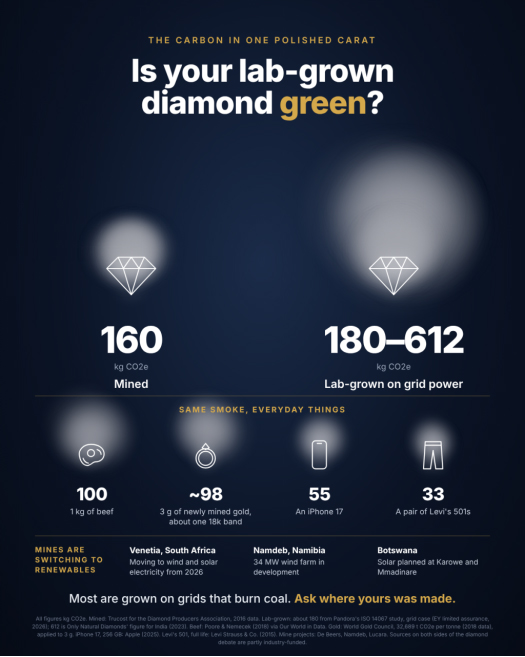 Carbon per polished carat, with everyday comparisons. Graphic: Antony Dear. Sources listed below.
What the mines are doing
The miners are moving as well, although more slowly. De Beers says 48 MW of renewable capacity was built and energised in South Africa in 2025 through its Envusa partnership, to move the Venetia mine on to renewable electricity from 2026. Namdeb, the De Beers joint venture with the Namibian government, is developing a 34 MW wind farm at Kerbehuk, north of Oranjemund, as its sole customer. Lucara has invited bids for a 30 MW solar plant at its Karowe mine in Botswana, which it aims to commission in 2027 or 2028.
Renewable electricity will only take a mine so far. Much of a mine's carbon comes from diesel burnt in haul trucks and generators, and electrifying that fleet will take years. A mined diamond is unlikely to reach Pandora's 12.58 kg any time soon. The 160 kg figure is also ten years old, and the miners are overdue an update.
Where the data is weak
Every number in this debate has a weakness, and the trade should be honest about them.
- The Trucost figure uses 2016 data and was paid for by the miners.
- Pandora's figure is independently verified, but Pandora sells only lab-grown diamonds, and its 90% saving is measured against that same Trucost figure.
- The Only Natural Diamonds figures for India and China come from the natural diamond side, with no published method.
- "Polished in India" says nothing about where a stone was grown. India imports large volumes of lab-grown rough as well as growing its own, so the power behind any one stone is often unknown to the person selling it.
What the trade lacks is a single method, applied to mines and growers alike and checked independently. Until that exists, every carbon claim on either side deserves a question.
What buyers and retailers should ask
If a jeweller sells you a lab-grown diamond on its environmental credentials, ask four things:
- Where was the stone grown, and by whom?
- What powered the reactor: grid electricity, or a documented renewable supply?
- Is there a carbon figure per carat, and who verified it?
- Is the gold or platinum in the setting recycled?
Retailers who sell on sustainability should be able to answer all four, and the best way to do that is to buy from growers who can prove their power source. Pandora has shown that publishing a verified figure per stone is possible. The best Indian growers already have the solar plants to back such a claim. The rest of the trade should be able to prove a green claim before making it.
Sources
Trucost for the Diamond Producers Association (via Rapaport): https://rapaport.com/?p=30343
Pandora carbon footprint labelling: https://www.pandoragroup.com/media/press-releases/pandora-adds-carbon-footprint-label-for-lab-grown-diamonds
Pandora grid-electricity scenario (Rough & Polished): https://rough-polished.expert/en/exclusive/145068.html
Only Natural Diamonds, India and China figures (Statista): https://statista.com/statistics/1427572/cut-and-polished-lab-grown-diamond-carbon-footprint-worldwide-by-region
Edahn Golan, Lab-Grown Diamond Value Chain 2025 (JCK): https://www.jckonline.com/?p=247771
Ember, India electricity data: https://ember-energy.org/countries-and-regions/india
Greenlab Diamonds renewable power (Rapaport): https://rapaport.com/?p=53048
Lukson and AVP Star solar facility (India CSR): https://indiacsr.in/lukson-solar-powered-lab-grown-diamond-facility/
Dholakia Technologies solar project: https://journalofcyberpolicy.com/?p=228311
Kira solar plant (National Jeweler): https://nationaljeweler.com/articles/12769-indian-lab-grown-diamond-manufacturers-keep-growing
Beef, Poore and Nemecek via Our World in Data (Statista): https://statista.com/statistics/1201677/greenhouse-gas-emissions-of-major-food-products
World Gold Council gold emissions (Mining.com): https://www.mining.com/web/gold-mining-emissions-draw-scrutiny-after-price-surge/
Apple iPhone 17 Product Environmental Report: https://www.apple.com/environment/pdf/products/iphone/iPhone_17_PER_Sept2025.pdf
Levi's 501 lifecycle (The Ethos): https://the-ethos.co/legacy-denim-brands-sustainability/
De Beers 2025 sustainability report (Engineering News): https://engineeringnews.co.za/article/de-beers-publishes-2025-sustainability-report-2026-09-23
Namdeb Kerbehuk wind farm (Windhoek Express): https://www.we.com.na/mw-main/namdeb-and-nampower-partner-up2025-05-13156927
Lucara Karowe solar tender (TaiyangNews): https://taiyangnews.info/tenders/lucara-botswana-seeks-30-mw-solar-for-diamond-mine
India lab-grown rough imports (National Jeweler): https://nationaljeweler.com/articles/12769-indian-lab-grown-diamond-manufacturers-keep-growing