Rare Interpenetrant Twin Reveals the Fascinating Complexity of Natural Diamond Growth
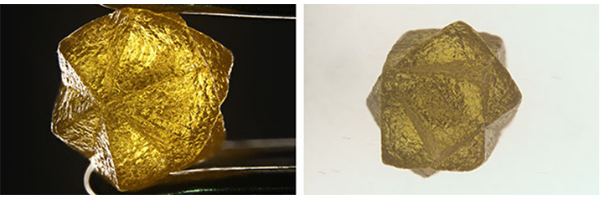 Image source: gia.edu
A rare natural diamond exhibiting an unusual phenomenon known as interpenetrant twinning is offering a fascinating glimpse into the extraordinary processes that shape diamonds deep within the Earth.
Recently examined by the Gemological Institute of America (GIA), the 0.37-carat vivid orangy yellow rough diamond is on loan from the GIA Museum. Its unusual structure reveals two diamond crystals that have grown into one another, creating an intricate natural formation.
Crystal twinning occurs when two crystals of the same mineral grow together in a symmetrical relationship. In diamonds, twinning can occur as either contact or penetration twinning. While contact twins, or macles, are relatively familiar in octahedral diamonds, interpenetrant twinning is far rarer, particularly in cuboid diamonds displaying fibrous growth.
The diamond was also subjected to spectroscopic analysis to understand the origins of its distinctive color and internal characteristics. Ultraviolet/visible spectroscopy showed broad absorption concentrated primarily in the violet-to-blue regions of the visible spectrum, consistent with coloration associated with isolated substitutional nitrogen atoms, known as C-centers.
Fourier-transform infrared spectroscopy further identified both C-centers and A-centers, which consist of paired nitrogen atoms. The findings classify the diamond as type IaA+Ib.
Beyond its vivid color, the specimen highlights one of natural diamond's most compelling qualities: its individuality. Every natural diamond records a unique history of growth, and rare features such as interpenetrant twinning reveal the unexpected twists and turns that can occur during crystal formation.
For the jewellery industry and diamond enthusiasts alike, such specimens demonstrate that natural diamonds are more than gemstones. They are natural records of geological time, with structures and characteristics created by processes that cannot be replicated by design.
The GIA examination underscores how even an unusual "accident" during crystal growth can produce a remarkable mineral specimen, offering scientists and the industry another window into the complex world of natural diamond formation.