BY DAVID TROOSTWYK
As my attention turns to Singapore and the 41st World Diamond Congress, I find myself compelled to write about what I believe is a more important moment than the industry might realise. This is an election year for the World Federation of Diamond Bourses and what happens in that room will shape the direction of this 80 year old diamond institution for years to come.
There will be a changing of the guard. After two terms and six years in office, the incumbent President and Executive Council are stepping down. Six years that, by any measure, were the most turbulent in the industry's long history. From the pandemic, to synthetic diamonds, conflict in the Middle East to US tariffs, and the sale of De Beers itself. No one could have envisaged it all, or the cumulative weight it would place on the global trade.
Yet the response was one of resilience. The leadership responded with unity, and supported the NDC through membership and donations to drive category marketing for natural diamonds. They went further, developing their own category marketing campaign to reinforce the message, and most recently, welcomed Botswana and Angola as affiliate members, strengthening reach and influence across the producing world. For everything the trade faced over the last six years, the outgoing leadership should be commended for their commitment and for continuing to move the organisation forward.
Now we face a different question. What comes next?
To understand why this moment matters, we need to look back before we look forward. The WFDB was formed after the Second World War because the international diamond trade needed a common framework to function across borders. Its founding purpose was straightforward; create common trading rules for rough and polished diamonds, promote ethical conduct and trust between traders, provide a mechanism for resolving disputes, and represent the trade's interests collectively, at a time when no single nation or company could do so alone.
What made the WFDB powerful was not the rulebook but what membership guaranteed: any member of an affiliated bourse knew every other had agreed to the same code, and that trust let dealers do business across borders with people they’d never met, in countries they’d never visited. All this was backed by real consequences, break an agreement and risk not just expulsion from your own bourse, but ostracisation across an entire global network.
It built on this foundation for decades, helping establish the World Diamond Council 2000 (which drove the Kimberly process and curbed the trade in conflict diamonds,) working with the International Diamond Manufacturers association to set the grading terminology the trades still uses today, and publishing and enforcing a code of principles regarding synthetic disclosure, treatment, and ethical conduct.
What has changed is not the value of these measures but the shape of the trade around them. As manufacturing moved east and digital trading removed the need for a physical floor, fewer transactions had to run through a bourse at all. In some places, membership drifted from being a functional necessity in the middle of a career to a status marker at the end of one. But the underlying need for a bourse, in a trade facing more scrutiny and compliance pressure than it has in decades, is stronger than ever.
The question is whether the WFDB modernises the mechanism or allows the reason it was built to become irrelevant.
There is a fork in the road here. One path leads to continuity, reacting to events as they come and preserving what exists. There is nothing dishonourable about this, but it leads gradually, and then suddenly, to an organisation of diminishing relevance.
The other path is transformation. Building on the original purpose, but for today's world. Reforming the trusted global network for an increasingly digital environment, policing the behaviour of industry participants, enforcing ethical trading with real consequence, and standing fully behind the NDC and the natural diamond story. This is paramount, the natural diamond remains the most powerful story our trade has ever told, and it needs a unified and confident voice behind it.
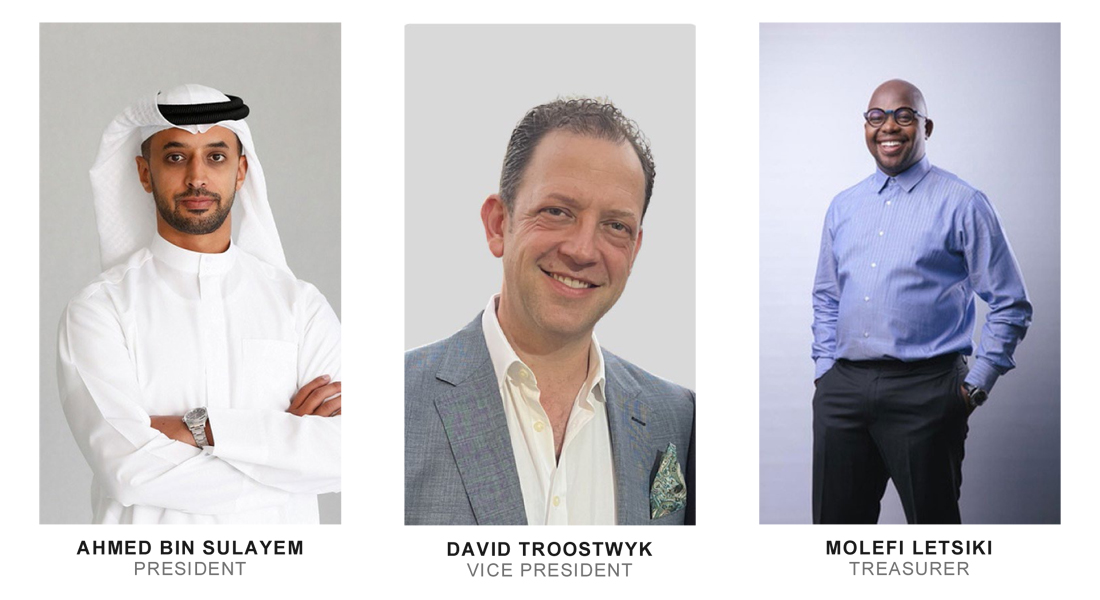
The trade needs vitality, energy and a modern outlook to be able to defend itself going forward. That is the leadership I am urging the bourse presidents descending on Singapore to vote for. A new executive consisting of Ahmed Bin Sulayem as President, David Troostwyk as Vice Presidents and Molefi Letsiki as Treasurer. A team that reflects the full breadth and ambition this Federation needs.
Ahmed Bin Sulayem — President
Over two decades, Ahmed Bin Sulayem has delivered one of the most consequential leadership performances our industry has seen. As Executive Chairman and CEO of the Dubai Multi Commodities Centre and Executive Chairman of the Dubai Diamond Exchange, he built Dubai from a peripheral player into one of the world's largest trading hubs. Twenty-eight thousand businesses call the DMCC home, fourteen hundred of them in precious stones, and the Dubai Diamond Exchange is now one of the world's largest diamond exchanges. He has chaired the Kimberley Process three times, most recently as Custodian Chair in 2025, an unmatched record of trust from producer states, trading centres and civil society alike. His network runs from African heads of state to the manufacturing centres of India to the retail groups of Asia, the Gulf and the West. Few people in this industry have convened the trade at this scale, or this effectively. There is no question about the impact Ahmed can have on revitalising the relevance and ambition of the WFDB.
David Troostwyk — Vice President
Over twenty years in the natural diamond trade, I have built my career from the ground up. With no family network or business to inherit, I made my way through the industry under my own steam, founding Salotro, a specialist advisory trusted by leading brands and independent designers alike, built entirely on relationships and reputation. I served as President of the London Diamond Bourse, where I led its modernisation by increasing London’s relevance on a global stage, implementing new educational infrastructure, adding new revenue streams, and working closely with government and industry bodies. I founded CiviGem, the digital platform connecting the global trade, built on the same principles that has driven everything I have done, trust, integrity and quality.
This is the model I intend to bring to the WFDB. I have spent my career championing natural diamonds, not as a commodity, but as objects of meaning that deserve a confident voice in a market being reshaped by synthetics and shifting consumer expectations. I have re-energised institutions by treating the members as the client, not the audience, and I have built my businesses by focusing on trust and forward thinking. As Vice President, my focus will be exactly that. Collaboration and galvanisation. Building a WFDB that champions the natural diamond story with the energy and trust the federation and its membership need now more than ever.
Molefi Letsiki — Treasurer
Molefi's story begins before he ever saw a diamond. The son of a polisher, raised on stories of these stones, until an afternoon after school when he watched one being cut and a flash of scintillation changed everything. Today he is Founder and Director of Molefi Letsiki Diamonds, the first majority Black-owned De Beers Sightholder in the world, President of the Diamond Gem and Jewellery Association of Southern Africa, a WFDB Executive Council Member, and a World Diamond Council Ambassador.
The WFDB's biggest recent achievement was bringing producing nations in as affiliates and Molefi is that world. A practitioner who has built his career inside beneficiation, youth 4 development and ethical trade, not observed it from the outside. A Federation that claims to represent the global trade needs a voice like his at its centre, not at its edges.
What makes this ticket different from any leadership pitch heard before, is that it’s not the Federation being asked to gamble on outsiders, but instead is the Federation's own investment reaching maturity.
Years ago, Rami Baron, himself a WFDB Executive Council member, looked at this industry and decided it should not leave its next generation of leaders to chance. On his own WFDB initiative, he built the Young Diamantaires (YD). A group with no hierarchy and no agenda, where young leaders from every corner of the trade could question anything and be judged by nothing but their thinking. As a group, the YD’s have travelled to mines together, visited Surat together, and built a science laboratory for a school in an African mining community together.
Ahmed, Molefi and I are all members of this family and I have sat on the YD board for years. This is the Federation's own investment coming home.
What we are offering, in short, is an executive built to modernise the Federation's infrastructure and voice. To raise, not just administer, the standards that protect our members, and to do all of it with the energy, the optimism and the hard earned conviction that the best years of the natural diamond trade are still ahead of it.
Two choices are on offer in Singapore: the long road the WFDB has walked for the last eighty years, or something new, refreshing and modern, ready to serve its members, defend the trade and elevate the natural diamond category that is crying out for exactly this kind of leadership.
The vote is for your local Diamond Bourse President to make. The moment is now.
David Troostwyk is Former President and current Vice President of the London Diamond Bourse, Founder of Salotro and CiviGem, and Vice Presidential candidate for the World Federation of Diamond Bourses.